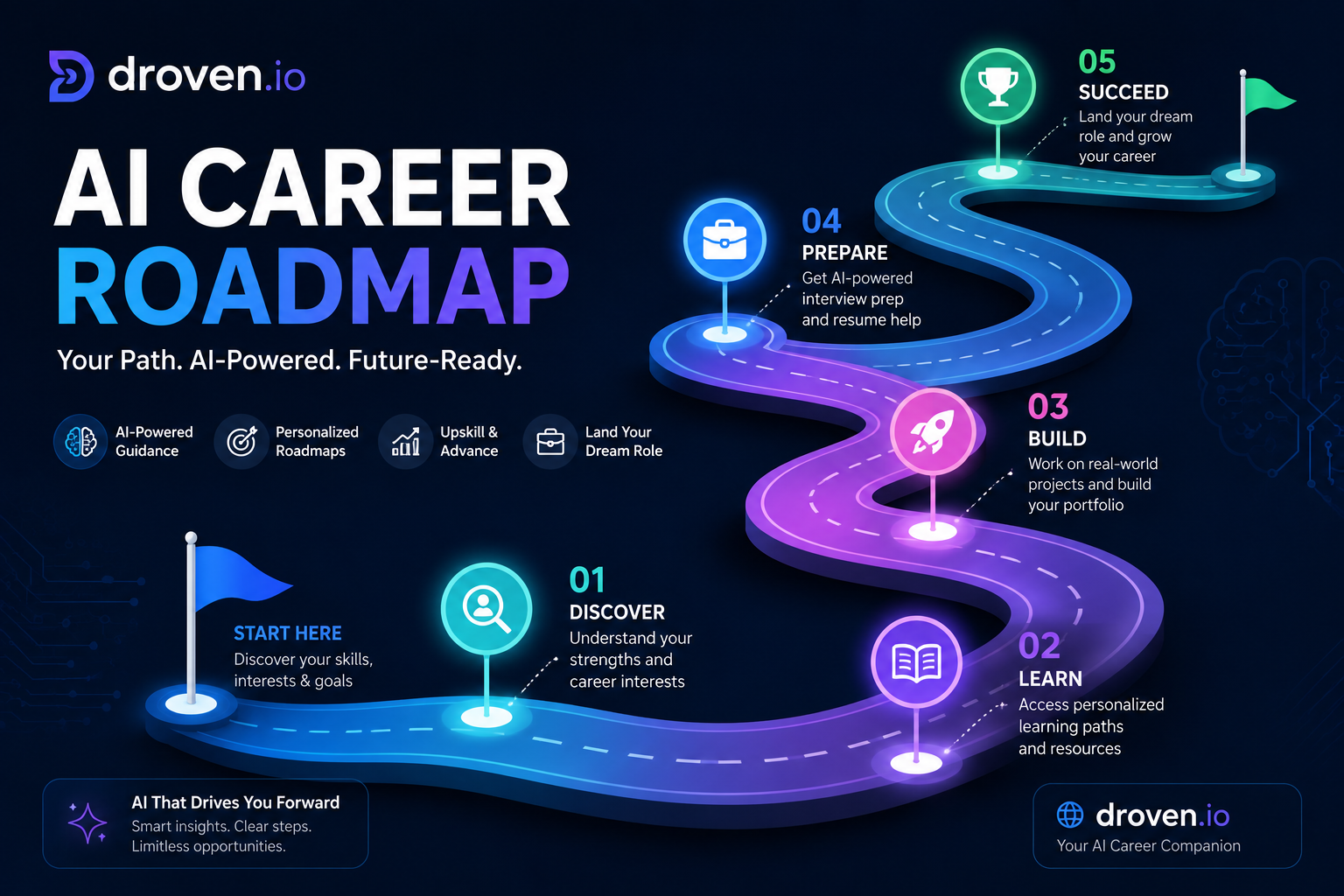
Starting an AI career can feel confusing. One guide recommends Python, another focuses on prompt engineering, and a third tells you to master advanced mathematics before building anything.
The result is often months of learning without a clear career direction.
The droven.io AI career roadmap search appears to reflect a need for something simpler: a structured path that connects AI skills, practical projects and realistic job roles. Droven.io itself is an editorial website covering artificial intelligence, emerging technology, software development and the future of work. At the time of writing, however, I could not verify a dedicated interactive career-roadmap tool on its official website.
Third-party articles use the phrase to describe a step-by-step AI learning framework. Therefore, this guide focuses on the practical roadmap readers are likely searching for rather than presenting Droven.io as a confirmed career-planning application.
What Is the Droven.io AI Career Roadmap?
The term generally refers to a structured plan for moving from basic AI knowledge to job-ready skills.
Instead of learning random tools, you progress through connected stages:
- Choose a realistic AI career direction.
- Build essential technical foundations.
- Learn machine learning and generative AI concepts.
- Create projects that prove your ability.
- Gain practical experience.
- Prepare for interviews and job applications.
- Continue updating your skills.
This is more useful than collecting certificates without understanding how the skills fit together.
Some competing articles describe the roadmap as a formal blueprint covering skills, projects, certifications and career milestones. However, those descriptions come from third-party websites rather than a clearly identified official Droven.io product page.
Start by Choosing the Right AI Career Path
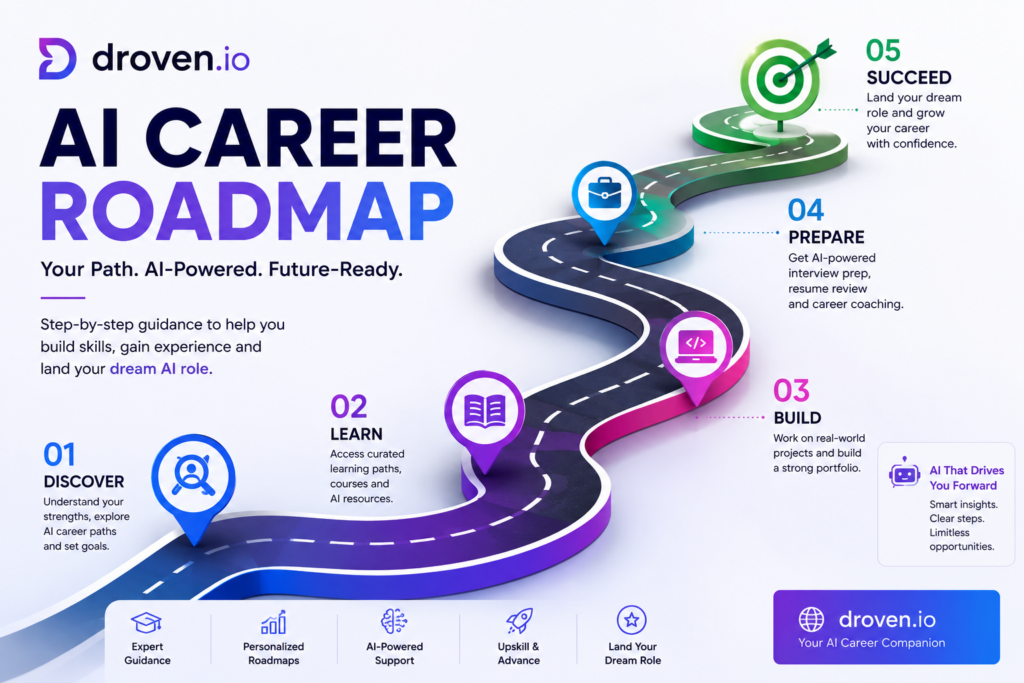
“Working in AI” can mean many different things. You do not need the same learning plan for every role.
Before selecting courses, decide which type of work suits your interests and current abilities.
| Career path | Main responsibilities | Important starting skills |
|---|---|---|
| Data analyst | Clean data, build reports and explain trends | Excel, SQL, statistics, visualization |
| Data scientist | Analyse data and create predictive models | Python, SQL, statistics, machine learning |
| Machine learning engineer | Build and deploy production ML systems | Python, ML frameworks, APIs, cloud tools |
| AI application developer | Add AI models to websites and software | Programming, APIs, prompt design, databases |
| Generative AI engineer | Build applications using language or multimodal models | Python, APIs, retrieval systems, evaluation |
| MLOps engineer | Deploy, monitor and maintain models | DevOps, cloud, containers, machine learning |
| AI product manager | Plan useful AI products and coordinate teams | Product strategy, AI literacy, communication |
| AI governance specialist | Review risk, privacy, fairness and compliance | Policy, risk management, AI fundamentals |
A beginner who enjoys business problem-solving may prefer data analytics or AI product work. Someone who likes programming and system building may be better suited to AI application development or machine learning engineering.
Choosing a target role early prevents unnecessary study.
Stage 1: Build the Core Foundations
Most technical AI roles require a combination of programming, data knowledge and basic mathematics.
Learn Python
Python remains a practical starting language because it is widely used for data analysis, automation and machine learning.
Focus first on:
- Variables, loops and functions
- Lists, dictionaries and sets
- Reading and writing files
- Error handling
- Object-oriented programming basics
- Virtual environments
- Working with APIs
- Git and GitHub
Do not spend months learning every part of the language before building something. Once you understand the basics, use Python in small projects.
Learn SQL and Data Handling
AI systems depend on data. Even when using ready-made models, you may need to collect, clean, filter and store information.
Learn how to:
- Select and filter records
- Join tables
- Group and aggregate data
- Handle missing values
- Detect duplicate records
- Work with CSV and JSON files
- Use dataframes
- Create simple charts
SQL is especially valuable because it appears in data analyst, data scientist, machine learning and business intelligence roles.
Understand the Necessary Mathematics
You do not need to become a mathematician before starting AI. However, you should understand the ideas behind:
- Averages and distributions
- Probability
- Correlation
- Vectors and matrices
- Functions and gradients
- Model error
- Optimisation
- Statistical testing
Learn the mathematics alongside practical examples. For instance, study probability while evaluating a classification model rather than treating it as an isolated subject.
Stage 2: Learn Machine Learning Fundamentals
Once you can work with Python and data, begin studying how machine learning models learn from examples.
Start with supervised learning:
- Linear regression
- Logistic regression
- Decision trees
- Random forests
- Gradient boosting
- Classification
- Regression
Then explore unsupervised learning:
- Clustering
- Dimensionality reduction
- Anomaly detection
More important than memorising algorithms is understanding the complete workflow:
- Define the problem.
- Collect suitable data.
- Clean and explore it.
- Select useful features.
- Split the data correctly.
- Train a baseline model.
- Evaluate its performance.
- Improve it carefully.
- Explain the result.
- Monitor it after deployment.
Learn common evaluation measures such as accuracy, precision, recall, F1 score and mean absolute error. The right measure depends on the problem. A medical screening model, for example, may require different priorities from a movie recommendation system.
Stage 3: Add Deep Learning and Generative AI
Deep learning becomes useful for areas such as image recognition, speech processing and natural language applications.
Begin with the concepts rather than immediately trying to train a massive model:
- Neural networks
- Activation functions
- Training and validation
- Overfitting
- Embeddings
- Transformers
- Attention
- Fine-tuning
- Inference
For generative AI careers, learn how to build reliable applications around existing models.
Useful topics include:
Prompt Design
Learn how instructions, examples, context and output formats affect a model’s response. Prompting is useful, but it should not be treated as a complete technical career by itself.
Retrieval-Augmented Generation
Retrieval-augmented generation, often called RAG, allows an application to retrieve relevant documents before generating an answer.
A typical RAG project involves:
- Document processing
- Text embeddings
- Vector search
- Context retrieval
- Prompt construction
- Answer generation
- Citation handling
- Quality evaluation
Model Evaluation
A demo that produces one impressive answer is not enough. You need to test:
- Accuracy
- Consistency
- Unsupported claims
- Citation quality
- Response time
- Cost
- Safety
- Performance on unusual inputs
This ability is becoming increasingly important because organisations need dependable systems, not just attractive demonstrations.
Stage 4: Build a Portfolio That Shows Real Ability
Certificates can support your learning, but projects provide stronger evidence of what you can do.
Aim for three to five polished projects rather than twenty unfinished notebooks.
Beginner Project Ideas
- Customer-sales dashboard
- House-price prediction model
- Email or review classifier
- Product recommendation prototype
- Customer-support FAQ assistant
- Document question-answering tool
- Job-description skill analyser
Each project should explain:
- The problem
- The intended user
- The dataset or information source
- Your technical approach
- The evaluation method
- The result
- The limitations
- What you would improve next
For example, do not simply write, “I created an AI chatbot.” Explain what information it uses, how retrieval works, how you test unsupported answers and how the application handles missing information.
That explanation demonstrates judgement, not just coding.
A Realistic Six-Month Learning Plan
The schedule below suits a learner studying consistently alongside school or work. The exact speed will depend on previous experience.
| Month | Main focus | Suggested outcome |
| 1 | Python, Git and basic data handling | Complete two small Python projects |
| 2 | SQL, statistics and data visualisation | Build an analysis dashboard |
| 3 | Machine learning fundamentals | Train and compare several models |
| 4 | APIs, deployment and model evaluation | Publish a working ML application |
| 5 | Generative AI, embeddings and RAG | Build a cited document assistant |
| 6 | Portfolio, interview practice and applications | Publish case studies and apply selectively |
Avoid treating this schedule as a guarantee. Some learners may need longer for programming fundamentals, while experienced developers may progress more quickly.
Stage 5: Learn Deployment and Production Skills
A model running in a notebook is not the same as a usable product.
Employers value people who understand how an AI system connects with real users and business processes.
Learn the basics of:
- REST APIs
- Web application frameworks
- Databases
- Docker
- Cloud deployment
- Authentication
- Logging
- Testing
- Version control
- Model monitoring
- Cost tracking
You do not need to master every cloud platform. Choose one environment and learn how to deploy a small but complete application.
For generative AI projects, monitor model cost, response quality, latency and failure cases. A system that works but is too expensive or unreliable may not be useful.
Stage 6: Develop Human and Business Skills
Technical knowledge alone does not guarantee career success.
Strong AI professionals can translate technical results into clear business decisions.
Develop your ability to:
- Define a problem before choosing a model
- Ask useful questions
- Explain uncertainty
- Write clear documentation
- Present findings to non-technical people
- Work with designers and product teams
- Consider privacy and security
- Identify bias and limitations
- Measure whether a solution creates value
For example, a highly accurate model may still fail if employees cannot understand it, customers do not trust it or the organisation lacks reliable data.
AI careers are ultimately about solving real problems, not displaying the largest number of tools on a résumé.
Stage 7: Prepare for Jobs Strategically
Do not wait until you feel like an expert. Very few applicants know everything listed in a job description.
Instead, compare job posts for your chosen role and identify repeated requirements.
Create a simple skills table with three columns:
- Skills you already have
- Skills you can demonstrate through projects
- Skills you still need to learn
Your résumé should emphasise outcomes rather than course lists.
A weak project statement says:
Built a machine learning model using Python.
A stronger version says:
Built and evaluated a customer-churn model, compared three algorithms and created a simple dashboard explaining the most important risk factors.
Prepare to discuss trade-offs, mistakes and limitations. Interviewers often learn more from how you improved a project than from its final score.
Common Mistakes to Avoid
Following Every New AI Trend
New tools appear constantly. Learn durable concepts such as data quality, evaluation, software design and problem definition before chasing every new product.
Collecting Courses Without Building
Watching lessons feels productive, but active work creates deeper understanding. Build something after each major topic.
Copying Projects Exactly
A copied tutorial does not prove independent ability. Change the dataset, user, feature set or evaluation process.
Ignoring Communication
Even technically strong work can be rejected when it is poorly explained. Add a readable README, screenshots, setup instructions and honest limitations.
Believing Guaranteed Salary Claims
AI salaries vary widely by country, experience, employer, education and job responsibilities. Treat claims about guaranteed high-paying roles with caution.
Is the Droven.io Roadmap Worth Following?
The droven.io AI career roadmap concept is useful when treated as a structured learning framework: foundations, machine learning, generative AI, projects, deployment and job preparation.
However, readers should understand that Droven.io currently presents itself as an editorial source for AI, technology and future-of-work information. I could not confirm that it operates a personalised assessment system, progress tracker or official roadmap generator.
Use its educational material as one information source, but verify tools, job requirements and technical advice through official documentation, current job listings and hands-on practice.
No roadmap can guarantee employment. Its value depends on whether you turn the guidance into visible, tested work.
Conclusion
A strong AI career does not begin with mastering every model. It begins with choosing a direction and learning the skills that support it.
Start with Python, SQL and data fundamentals. Add machine learning, generative AI and deployment skills gradually. Build projects that solve clear problems, evaluate their weaknesses and explain your decisions.
The best roadmap is not the one with the longest list of technologies. It is the one you can follow consistently, adapt as the field changes and use to produce evidence of real ability.
FAQs
Is Droven.io an AI career-roadmap tool?
Droven.io currently appears to be an editorial website covering AI, technology, digital transformation and future-of-work topics. I could not verify a dedicated interactive career-roadmap generator on its official website.
Can a beginner follow this AI roadmap?
Yes. Beginners can start with Python, data handling, SQL and basic statistics before moving into machine learning and generative AI. Learners without coding experience may need more time during the foundation stage.
How long does it take to become job-ready in AI?
There is no universal timeline. A learner with programming experience may build an entry-level portfolio within several months, while a complete beginner may need a year or longer. Consistent practice and project quality matter more than speed.
Do I need a degree for an AI career?
Some research and advanced engineering positions prefer or require formal degrees. However, portfolios, practical experience and strong programming skills may help candidates qualify for certain analytics, automation and AI application roles.
Which programming language is best for AI?
Python is generally the most practical first language because of its large data-science and machine-learning ecosystem. SQL is also highly valuable for working with business and application data.
Are AI certificates enough to get a job?
Usually not. Certificates can demonstrate structured study, but employers also need evidence that you can analyse data, build systems, evaluate results and explain your decisions.
For more updates visit: Tum Bons