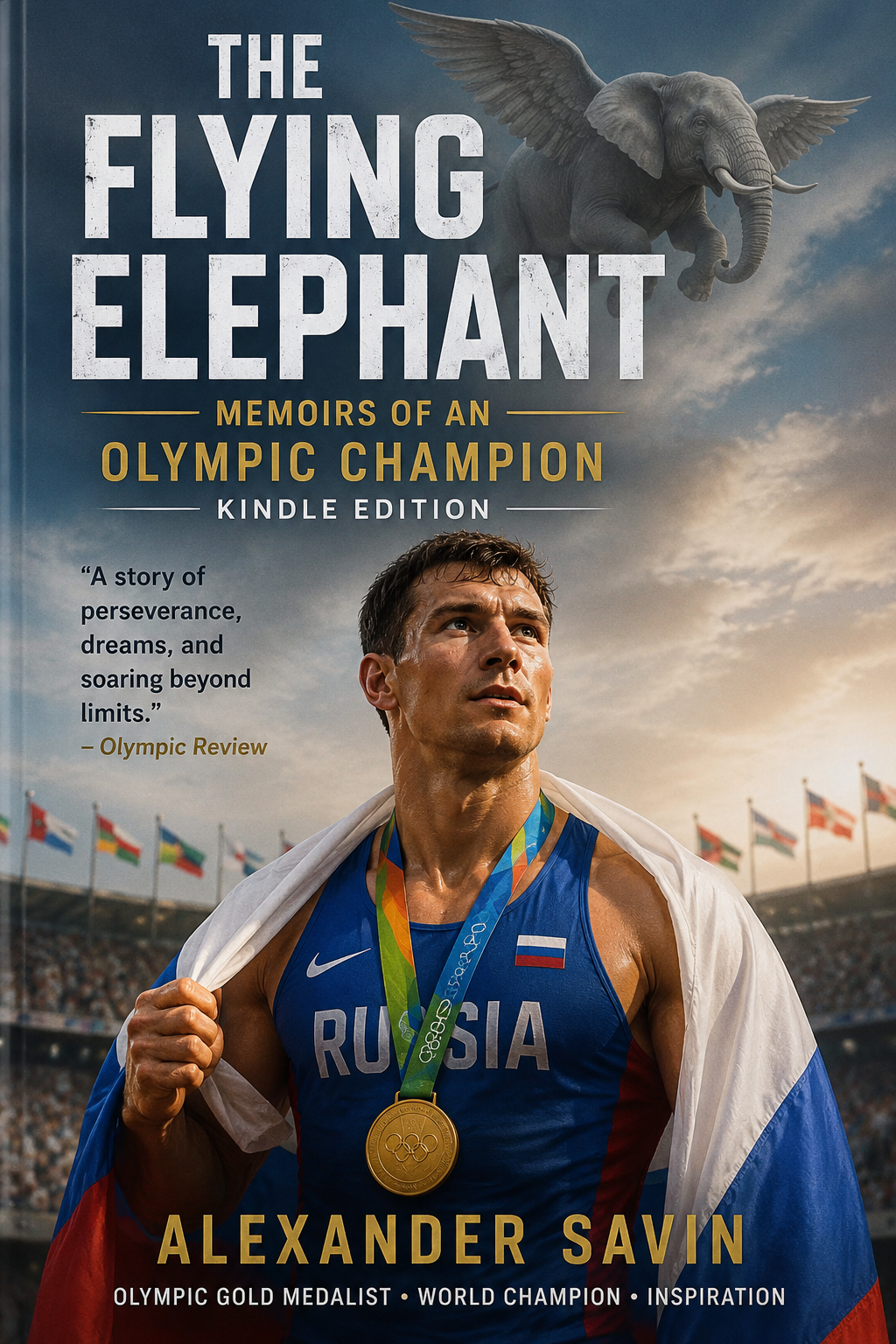
The search phrase the flying elephant memoirs of an olympic champion kindle edition alexander savin points to a recent English-language sports memoir about one of Soviet volleyball’s most decorated players. The book is presented as Alexander Savin’s account of elite competition, team culture, Olympic pressure, and the road from a promising athlete to a champion.
Savin’s sporting record gives the memoir real historical weight. He played in every Soviet match at the 1976 Montreal Olympics, where the team won silver, and all six matches at the 1980 Moscow Olympics, where it won gold. He was inducted into the International Volleyball Hall of Fame in 2010.
This guide separates verified information from promotional claims. It uses the Kindle listing, Savin’s official Hall of Fame profile, and public descriptions of the book. It does not pretend to be a first-hand review of every chapter.
The Book at a Glance

| Detail | Available information |
|---|---|
| Full title | The Flying Elephant: Memoirs of an Olympic Champion |
| Author | Alexander Savin |
| Format | Kindle eBook |
| Publication date | October 26, 2025 |
| Amazon identifier | ASIN B0FXVDWW16 |
| Main subject | Olympic volleyball, Soviet sport, teamwork, and athletic life |
| Credited contributors | Andrei Savine, Julia Savine, Peter Murphy, and Alfredo Cabero |
| Reported length | About 514 Kindle pages |
| Reported visual material | More than 240 photographs |
Amazon regional listings confirm the title, author, Kindle format, publication date, and contributor credits. Public book guides consistently report a 514-page length, a large file size, and more than 240 photographs, but buyers should check their local Amazon page because digital-edition details can change.
Who Is Alexander Savin?
Alexander Savin is also written as Aleksandr Savin in many sporting records. The Kindle listing uses “Alexander,” while the International Volleyball Hall of Fame uses “Aleksandr.” Both names refer to the same athlete.
Born in Taganrog in 1957, Savin became a leading Soviet middle blocker. At Montreal 1976, the Soviet team reached the final but lost a five-set match to Poland. Four years later in Moscow, Savin again appeared in every match as the Soviet Union defeated Bulgaria for Olympic gold.
His career was larger than two Olympic tournaments. The Hall of Fame also records Soviet victories during his era at the 1977 World Cup, the 1978 World Championship, and the 1975, 1977, and 1979 European Championships. It describes him as a key figure in the team’s return to Olympic gold.
This background matters. The memoir is not based on one lucky tournament. It comes from a player who competed inside one of international volleyball’s strongest systems during a politically tense period.
What Is The Flying Elephant About?
Public descriptions present the book as a broad life-and-career memoir rather than a short account of the 1980 final. It appears to combine personal memories, volleyball history, reflections on teammates and coaches, and a large photographic archive.
Reported topics include:
- Savin’s childhood and early athletic development
- Entry into elite Soviet volleyball
- The disappointment of the 1976 Olympic final
- Preparation for and victory at Moscow 1980
- Training routines, team relationships, and competitive pressure
- Life after top-level competition and coaching
- Photographs spanning several decades of volleyball history
These themes appear consistently across current book guides, but detailed chapter descriptions should be treated as summaries unless confirmed through the Kindle sample or the book itself.
Why Is It Called “The Flying Elephant”?
Several public guides explain the nickname as a reference to Savin’s combination of size, power, speed, and jumping ability. In that reading, the “elephant” reflects his imposing physical presence, while “flying” describes the movement and elevation that made him dangerous at the net.
The explanation is believable, but the exact origin of the nickname is not documented in the accessible Amazon listing or official Hall of Fame profile. It is therefore safer to describe this as the commonly reported meaning rather than a fully verified historical quote.
As a title, it works because it captures the contradiction at the center of elite sport: a large athlete moving with unexpected lightness and speed.
What Makes the Kindle Edition Different?
The Kindle edition appears to be highly visual. Public descriptions report more than 240 photographs and a file size of roughly 68.8 MB, which is unusually large for a text-based memoir.
That creates three practical considerations.
Choose the Right Screen
A basic Kindle e-ink reader should be comfortable for text, but photographs will normally appear in grayscale. A tablet or computer running the Kindle app may be better for viewing larger or color images.
Readers purchasing the book mainly for its photographic archive should consider using a device that supports a larger, full-color display.
Check Storage Before Downloading
A photo-heavy eBook needs more space than a normal novel. Readers using an older device, limited mobile data, or restricted storage should check the current download size before purchasing.
Confirm Regional Availability
The Kindle edition appears in several Amazon markets, but price, taxes, promotions, and Kindle Unlimited eligibility can vary by country. Always use the current local listing rather than an old quoted price.
What Readers Can Learn From Savin’s Story
Although the memoir is centered on volleyball, its most useful ideas are likely to extend beyond the court.
Discipline Is Built Through Repetition
Olympic success is often reduced to one winning moment. In reality, that moment follows years of repetitive training, travel, physical fatigue, tactical preparation, and strict routines.
Savin’s career illustrates that natural ability may open a door, but consistency is what allows an athlete to remain at the highest level.
Failure Can Shape Future Success
The Soviet Union entered the 1976 Olympics as a powerful team but lost the final to Poland. That defeat forms an important contrast with the gold-medal performance in Moscow four years later.
For athletes and coaches, the larger lesson is not that every defeat automatically produces victory. It is that failure can reveal weaknesses, sharpen preparation, and change how a team responds under pressure.
Team Success Is More Than Individual Talent
Volleyball depends on timing, positioning, communication, and trust. Even a dominant middle blocker cannot control a match alone.
A memoir from Savin’s perspective can therefore provide value to readers interested in how individual excellence operates inside a demanding team structure.
Sporting Achievement Has a Human Cost
Elite athletes are often remembered through medals and photographs. Less attention is given to time away from family, physical exhaustion, strict schedules, injuries, selection pressure, and uncertainty about life after competition.
A detailed memoir can help readers see the person behind the result.
Who Should Read This Memoir?
Volleyball Players and Coaches
Savin’s position and competitive era make the book especially relevant to readers interested in blocking, team systems, preparation, coaching culture, and performance under pressure.
Younger players may also benefit from comparing older training methods with modern approaches involving video analysis, sports science, recovery technology, and performance data.
Olympic and Cold War Sports Readers
The 1976 and 1980 Games carried political meaning far beyond sport. The Moscow Olympics were disrupted by a major international boycott connected to the Soviet intervention in Afghanistan.
A Soviet athlete’s perspective may add human detail that official reports, medal tables, and match results cannot provide.
Readers of Detailed Sports Biographies
At a reported 514 pages, this appears to be a substantial memoir rather than a quick motivational read. It is better suited to readers who enjoy long-form stories about training, failure, teamwork, competition, and life after professional sport.
Sports-History Collectors
The reported photographic archive may be one of the edition’s biggest strengths, particularly for readers interested in Soviet volleyball figures, uniforms, training environments, coaches, venues, and major tournaments.
Possible Limitations
The memoir may not suit someone seeking a short self-help book. Readers with little interest in volleyball, Olympic history, or Soviet sport may also find some material specialized.
The digital format could disappoint collectors who prefer a printed book. Photo-heavy content may feel less impressive on a small black-and-white screen than on a tablet.
English-language review volume also appears limited. Buyers should not treat a small number of ratings as a broad public verdict. The Kindle sample, table of contents, and product details are more useful decision tools.
Readers should also be cautious about websites that describe the memoir as the “best” or “greatest” sports autobiography without explaining how that conclusion was reached. Those descriptions are subjective marketing language, not independently verified facts.
How to Decide Before Buying
Use this five-step check before purchasing:
- Read the Kindle sample. Check whether the translation, pacing, and level of volleyball detail suit you.
- Verify the listing. Confirm the current price, page count, file size, and Kindle Unlimited eligibility.
- Choose a suitable device. A larger screen is preferable if the photographs are important to you.
- Match the subject to your interests. The strongest fit is volleyball, Olympic history, Soviet sport, and elite performance.
- Ignore exaggerated claims. Savin’s medals and Hall of Fame status are verified; labels such as “the greatest memoir ever” are opinions.
Is It Worth Reading?
For the right reader, the available evidence suggests a distinctive sports memoir. Savin’s career is unquestionably significant, and the English Kindle edition appears to offer a rare personal perspective on Soviet volleyball’s dominant years.
Its strongest selling points are the author’s verified experience, the historical setting, and the reported photographic archive. Its possible drawbacks are the length, specialized subject matter, limited public review volume, and digital format.
The fairest conclusion is simple: it looks most valuable for volleyball fans, coaches, Olympic researchers, and readers who prefer detailed sporting history to celebrity-style storytelling.
Conclusion
The Flying Elephant: Memoirs of an Olympic Champion stands out because its author helped shape the era he describes. Savin’s verified Olympic and Hall of Fame record gives the memoir authority, while its reported photographs and length suggest a substantial historical resource as well as a personal story.
Buy it for a genuine interest in volleyball, Olympic competition, Soviet sport, or first-person athletic history. Check the Kindle sample and current regional listing, and treat unsupported promotional claims cautiously. That is a better basis for choosing the book than hype alone.
FAQs
Who Wrote The Flying Elephant: Memoirs of an Olympic Champion?
The memoir is credited to Alexander Savin, the Soviet volleyball player who won Olympic silver in 1976 and gold in 1980. Amazon also lists Andrei Savine, Julia Savine, Peter Murphy, and Alfredo Cabero in contributing roles.
Is Alexander Savin the Same Person as Aleksandr Savin?
Yes. They are different English transliterations of the same Russian name. “Alexander” appears on the Kindle listing, while “Aleksandr” appears in official sporting records.
Is the Book Available Only on Kindle?
The verified listings found for this article are Kindle eBook listings. Print availability was not confirmed, so readers should check the current seller page or official author information before assuming that no print edition exists.
How Long Is the Book?
Public guides report about 514 Kindle pages. Page counts can display differently across devices and editions, so treat this as approximate listing information.
Does the Memoir Include Photographs?
Multiple public descriptions report more than 240 photographs. Readers should confirm the latest product description because digital editions can be revised.
Must Readers Understand Volleyball?
No, but knowledge of the sport will make tactical and historical details easier to appreciate. The broader themes—discipline, defeat, teamwork, pressure, and legacy—can still appeal to general sports readers.
For more updates visit: Tum Bons