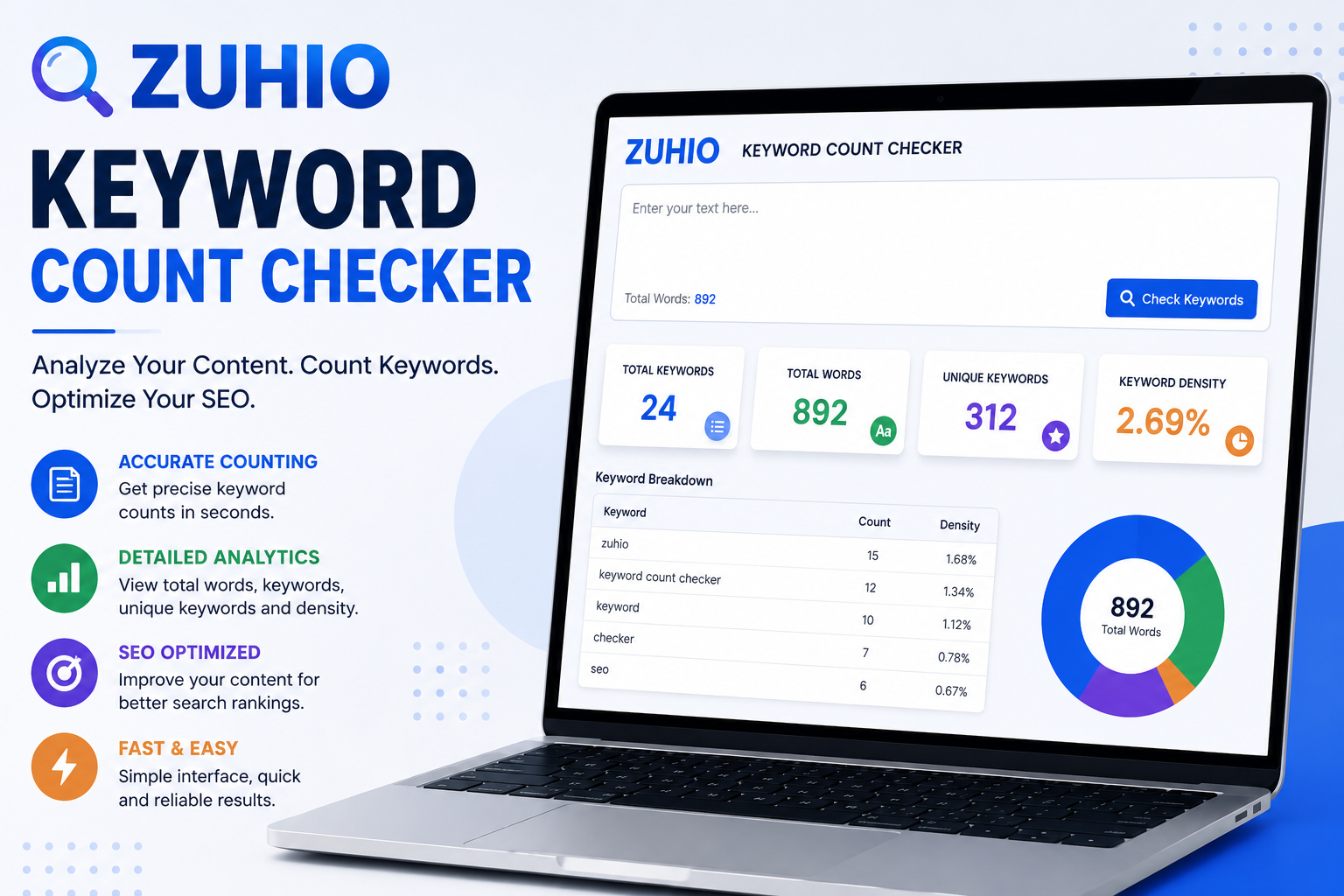
A keyword counter can reveal a problem that writers often miss: a phrase may barely appear in an article, or it may be repeated so often that the writing sounds unnatural.
The Zuhio Keyword Count Checker is presented as a lightweight content-analysis tool for reviewing keyword frequency in written content. Instead of manually searching through a long document, users can paste their copy into the checker and see how often particular words or phrases appear.
Its main value is simplicity. It can support the editing process, but it should not be treated as a complete SEO platform or a guaranteed way to improve rankings.
This guide explains what the tool appears to do, how to use keyword-count data properly, where it fits into an SEO workflow, and what it cannot tell you.
What Is the Zuhio Keyword Count Checker?
The Zuhio tool is designed to measure how frequently keywords appear in pasted content. It may be useful for reviewing:
- Blog posts
- Landing pages
- Product descriptions
- Service pages
- Affiliate articles
- Local business content
- Social media copy
- Existing pages being updated
Zuhio describes its broader platform as a collection of practical micro-tools intended to simplify business and professional tasks. Public descriptions of the keyword checker indicate that it focuses primarily on pasted-text analysis rather than advanced functions such as backlink research, search-volume estimates or rank tracking.
That narrow focus can be useful. A writer who only needs to identify repetition may not want to open a complex SEO suite, create a campaign or configure a website audit.
However, the checker’s complete feature set is not extensively documented on the official website. Users should verify the current interface directly because its options may change.
Keyword Count and Keyword Density Are Different
Keyword count is the raw number of times a term appears.
For example, if the phrase “email marketing software” appears eight times, its keyword count is eight.
Keyword density expresses that count as a percentage of the total content length:
Keyword density = keyword occurrences ÷ total words × 100
Consider a 1,200-word article containing a target phrase 12 times:
12 ÷ 1,200 × 100 = 1%
The percentage adds context. Twelve repetitions might be excessive in a 300-word page but reasonable in a detailed 2,500-word guide.
Still, density should be treated as an editing signal—not a target that guarantees rankings. There is no universal percentage that works for every topic, query or content format.
How the Checker Fits Into Modern SEO

Google’s systems evaluate far more than exact keyword repetition. A useful page must satisfy the reader’s intent, explain the subject clearly and provide information that deserves to be trusted.
Google’s guidance for core updates recommends meaningful, sustainable improvements rather than quick SEO fixes. It advises publishers to assess whether their pages are helpful, reliable and people-first.
The May 2026 core update ran from May 21 to June 2, 2026. Google did not publish a special keyword-density rule with that update. Therefore, claims that a particular density percentage is required by the update should be treated with caution.
A keyword counter remains useful because it can help you notice:
- Accidental repetition
- Missing topic phrases
- Inconsistent terminology
- Over-optimized paragraphs
- Weak keyword placement
- Differences between similar drafts
It cannot determine whether an article is original, accurate, satisfying or genuinely helpful.
How to Use Zuhio Keyword Count Checker
The exact interface may evolve, but publicly available descriptions suggest a straightforward pasted-text workflow.
1. Finish the Main Draft First
Write for the reader before checking frequency.
Trying to reach a keyword quota while drafting often produces awkward sentences. First explain the subject completely, answer important questions and organize the information logically.
Use the checker during editing.
2. Copy the Full Content
Include the parts that will appear on the published page, such as:
- Main heading
- Introduction
- Body copy
- Subheadings
- Conclusion
- FAQ answers
Leaving out headings may produce an incomplete picture because prominent page elements are part of the reader’s experience.
3. Paste the Text Into the Tool
Open the relevant checker on Zuhio and paste the draft into its input area.
Avoid entering private client information, passwords, unpublished financial details or other sensitive material into any third-party web tool unless you have reviewed its privacy terms.
4. Review Important Words and Phrases
Start with the page’s primary topic. Then review useful variations separately.
For an article about beginner email marketing, these might include:
- Email marketing
- Email campaigns
- Subscriber list
- Newsletter software
- Open rate
- Email automation
The purpose is not to force every variation into the page. It is to check whether the vocabulary accurately reflects the subject.
5. Examine Placement, Not Just Totals
A keyword appearing six times in one paragraph is less useful than six natural mentions distributed across relevant sections.
Review whether the main topic is clear in the:
- SEO title
- H1 heading
- Opening section
- Relevant subheading
- Main explanation
- Conclusion
- Image alt text, where appropriate
Do not insert the exact phrase into every heading. Headings should describe their sections naturally.
6. Remove Forced Repetition
Read each occurrence in context.
Delete or rewrite a mention when it:
- Adds no information
- Sounds grammatically awkward
- Repeats the previous sentence
- Interrupts the flow
- Exists only for SEO
- Could be replaced by a clearer reference
Natural alternatives, pronouns and closely related terms can make the page easier to read.
7. Recheck the Edited Draft
Run the revised version through the checker again.
Then read the page aloud. A numerical report may identify repetition, but your ear often catches unnatural wording more effectively.
A Better Keyword-Editing Workflow
A keyword report becomes more valuable when it is combined with other content checks.
| Editing check | Question to ask | Why it matters |
|---|---|---|
| Search intent | Does the page solve the reason behind the query? | Relevance depends on satisfying the user |
| Keyword frequency | Is the main phrase missing or overused? | Helps identify repetition and weak focus |
| Topic coverage | Are essential questions answered? | Creates a more complete resource |
| Readability | Can readers understand each section quickly? | Improves usability and engagement |
| Accuracy | Can important claims be verified? | Builds trust |
| Original value | Does the page add examples or useful insight? | Separates it from generic summaries |
| Internal links | Can readers reach related helpful pages? | Improves navigation and context |
| Page experience | Is the content easy to use on mobile? | Prevents friction |
This approach prevents a common mistake: polishing keyword density while ignoring the actual quality of the page.
What the Tool Can and Cannot Do
What It Can Help With
A keyword counter can help writers:
- Measure exact phrase frequency
- Find repeated terms
- Compare two versions of a draft
- Review long-form articles faster
- Check content before publication
- Update older pages
- Maintain consistent terminology
What It Cannot Reliably Measure
The checker cannot independently confirm:
- Search volume
- Keyword difficulty
- Ranking potential
- Backlink strength
- Search intent satisfaction
- Factual accuracy
- First-hand expertise
- Originality
- Conversion performance
- Technical SEO health
- Google indexing status
Public descriptions also suggest that Zuhio’s checker is a lightweight pasted-text tool rather than a complete website-audit platform. Users needing URL analysis, competitor research or ranking data may need additional tools.
Zuhio vs Other Keyword-Checking Methods
| Method | Main advantage | Main limitation | Best use |
| Manual counting | Requires no tool | Slow and easy to miscount | Very short copy |
| Browser Find | Fast exact-match search | Does not calculate broader metrics | Quick phrase review |
| Word processor search | Convenient during writing | Limited SEO context | Draft editing |
| Zuhio checker | Simple frequency analysis | Limited public feature documentation | Fast pasted-text checks |
| Density analyzer | Shows counts and percentages | May encourage fixation on ratios | Detailed repetition review |
| Full SEO platform | Broader research and auditing | More complex and often paid | Professional campaigns |
The right option depends on the task. A small checker may be enough for one article, while an agency managing hundreds of pages may require a broader content-optimization system.
Common Keyword Counting Mistakes
Chasing a “Perfect” Percentage
No fixed density guarantees a first-page position.
A short product page, news article and technical tutorial naturally use language differently. Forcing all three to meet the same percentage ignores context.
Counting Only the Exact Match
Modern content should include the vocabulary readers expect around a topic.
An article about home insulation may naturally mention energy efficiency, heat loss, insulation materials, attic insulation and energy bills. These related concepts help make the explanation complete.
Adding Keywords After Every Paragraph
This produces predictable, repetitive writing. Keywords should appear because they help communicate the subject—not because a formula demands another mention.
Ignoring Singular, Plural and Phrase Variations
A basic exact-match count may treat “keyword checker” and “keyword checkers” as different phrases. Review important variations manually before making major edits.
Assuming More Mentions Mean More Relevance
A page can repeat a term 40 times and still fail to answer the query.
Relevance comes from a clear, complete and useful response. Frequency only helps you inspect how language is being used.
How to Improve Content After Checking Keywords
Once you have reviewed the count, make improvements in this order:
- Confirm that the article answers the primary search intent.
- Remove paragraphs that repeat existing information.
- Add missing explanations, examples or comparisons.
- Correct unsupported or outdated claims.
- Improve headings so readers can scan the page.
- Replace forced exact matches with natural language.
- Add useful internal links.
- Check the title and description for clarity.
- Proofread for grammar and readability.
- Recheck the final frequency report.
This order matters. Improving usefulness should come before adjusting a percentage.
Is the Checker Worth Using?
The Zuhio Keyword Count Checker appears best suited to bloggers, freelancers, small website owners and beginner SEO writers who need a quick frequency check.
Its strongest advantage is likely convenience. Its main limitation is that keyword frequency represents only one small part of SEO.
Use it as a proofreading assistant rather than a ranking calculator. A healthy workflow combines keyword review with research, fact-checking, useful examples, natural language and strong page structure.
ALSO READ: Ironmartonline Reviews Is It Worth Trusting?
Conclusion
Keyword counting is most valuable when it reveals a writing problem—not when it becomes a writing goal.
Zuhio’s checker can help identify missing phrases and excessive repetition before content is published. However, the final decision should always be based on clarity, context and reader value.
Write the most useful answer you can, verify important claims, edit out repetition and then use frequency data as a final quality-control check. That approach is more sustainable than optimizing every page around an arbitrary keyword-density target.
FAQs
Is Zuhio’s keyword checker free?
Public descriptions indicate that the checker has been accessible online without a complicated setup. However, current access conditions, limits and pricing should be confirmed on the official website because these details may change.
Does keyword density still matter for SEO?
It can help identify whether language is being overused or barely included, but it is not a standalone ranking formula. Search intent, accuracy, content quality, page experience and authority are more meaningful parts of a complete strategy.
What is a good keyword density?
There is no universal ideal percentage. Use the phrase often enough to make the topic clear, but not so frequently that sentences sound forced. Compare the count with content length, placement and readability.
Can a keyword counter prevent keyword stuffing?
It can reveal unusually frequent repetition, but it cannot judge every sentence. You still need to read the content and remove phrases that add no value or make the copy unnatural.
Can I use it for old content?
Yes. Keyword analysis can support content refreshes by identifying outdated optimization, excessive repetition or inconsistent terminology. Also check facts, links, search intent and examples during the update.
Does the checker replace keyword research?
No. Counting tools analyze language already present in a draft. Keyword research tools explore demand, related searches, competition and audience questions. The two serve different purposes.
For more updates visit: Tum Bons