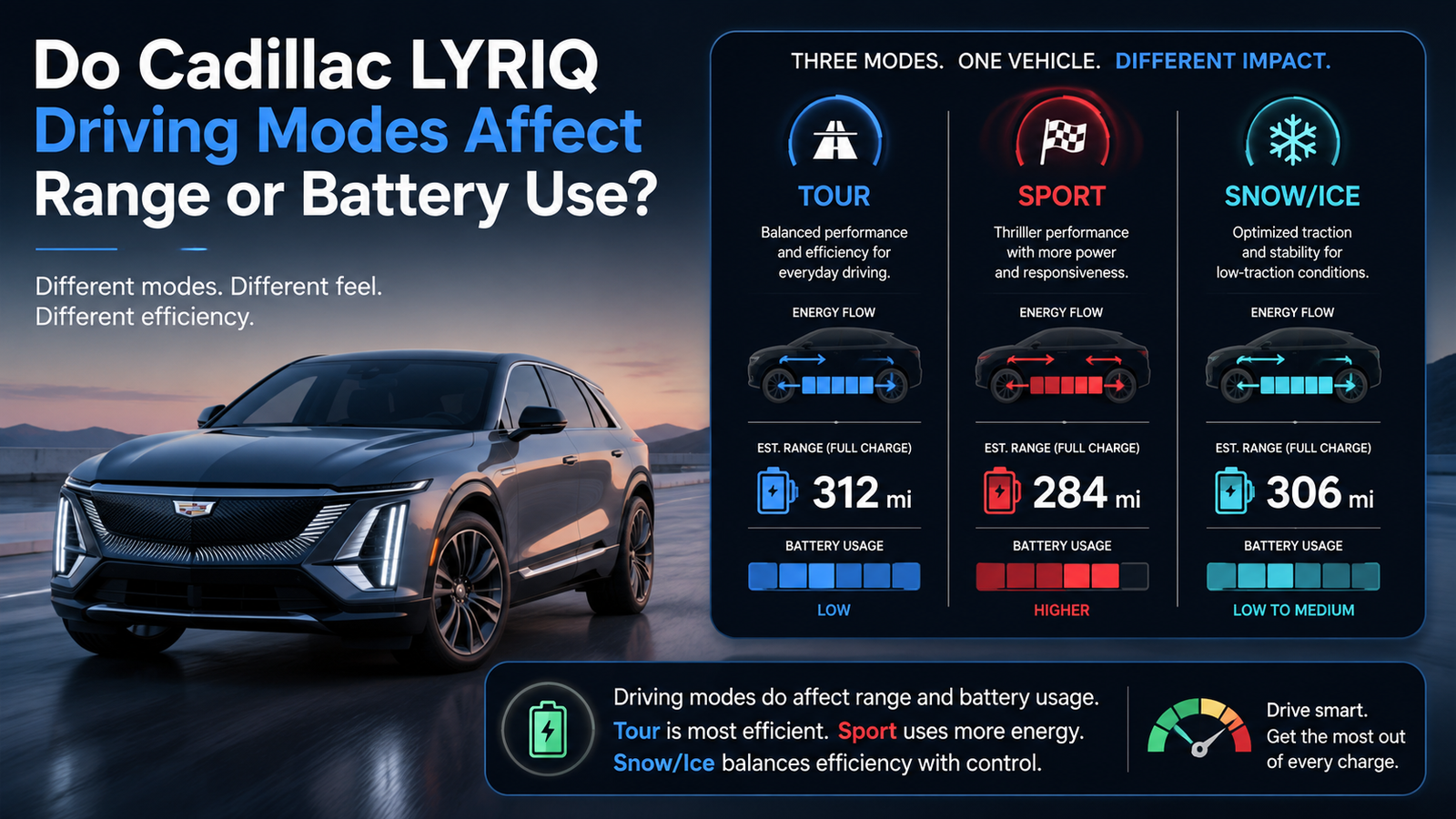
Do the driving modes in Cadillac LYRIQ offer different ranges or battery usages? Yes, but not as separate, guaranteed range ratings. Tour, Sport, Snow/Ice, and My Mode change how the LYRIQ responds to the driver and road. Those settings can influence real-world electricity use. However, they do not switch the vehicle to a different-size battery or assign a fixed number of miles to each mode.
The main difference comes from how each mode shapes accelerator response, traction, and driver behavior. Therefore, the same trip can use different amounts of energy in different modes.
Research note: This article was created from Cadillac’s 2026 LYRIQ owner’s manual, Cadillac’s current U.S. specifications, and EPA guidance. It does not claim a first-hand road test. Details were last checked on July 30, 2026.
Do the Driving Modes in Cadillac LYRIQ Offer Different Ranges or Battery Usages?
The official Cadillac materials reviewed for this article do not list separate EPA ranges for Tour, Sport, Snow/Ice, or My Mode. The EPA range applies to a vehicle configuration, such as rear-wheel drive, all-wheel drive, equipment package, or LYRIQ-V. A drive mode changes vehicle calibration, not the battery’s rated capacity.
For the 2026 U.S. model, Cadillac lists a 102 kWh rated-energy battery and up to 326 miles of EPA-estimated range for rear-wheel-drive versions. Cadillac places standard LYRIQ models in a 303-to-326-mile EPA range band, depending on configuration. The 2026 LYRIQ-V carries a separate 285-mile EPA estimate because it has performance-focused hardware and tuning. These are model-level ratings, not mode-by-mode promises.
Still, a selected mode can change accelerator mapping, suspension, steering, adaptive cruise behavior, or traction settings. More aggressive acceleration and greater traction demand usually require more power.
How Each LYRIQ Mode Can Affect Energy Use
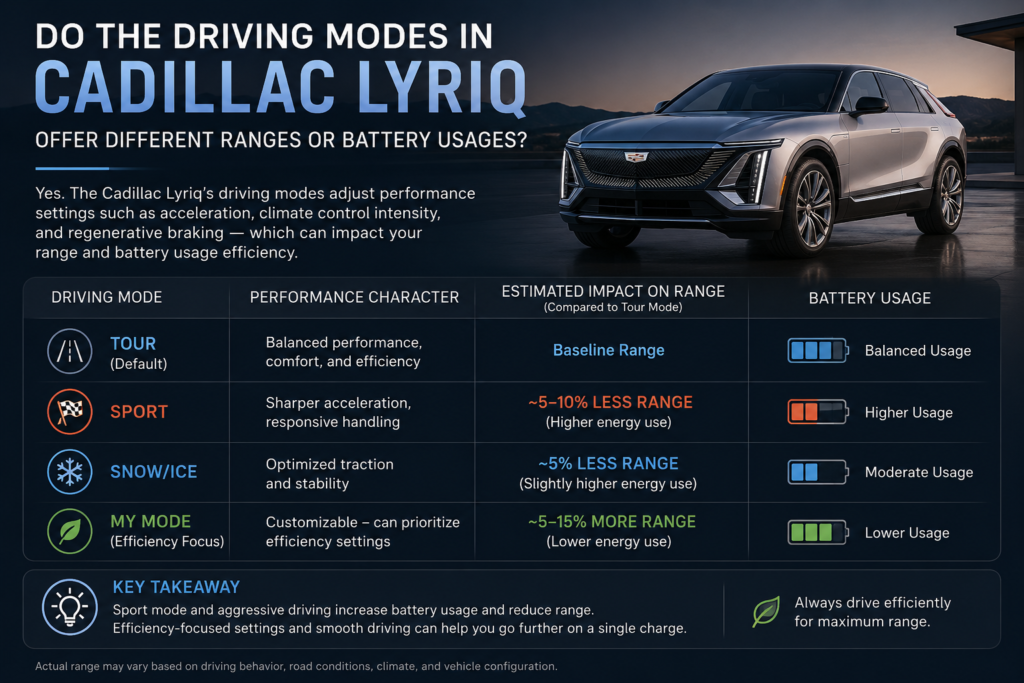
The table separates Cadillac’s verified mode descriptions from evidence-based efficiency expectations. Cadillac does not provide a guaranteed percentage difference between these modes.
| Drive mode | What Cadillac says it changes | Likely effect on battery use |
|---|---|---|
| Tour | Balances comfort and handling for normal driving | Usually the best baseline for efficient daily driving |
| Sport | Changes pedal tuning, steering, sound, adaptive cruise, and suspension when equipped | Can increase consumption if sharper response leads to harder acceleration |
| Snow/Ice | Softens pedal response, manages traction, and modifies electric AWD behavior | May reduce wheelspin, but winter conditions often raise consumption |
| My Mode | Lets the driver combine acceleration, braking, steering, suspension, and sound settings | Depends on the selected setup and driving style |
| V-Mode/Velocity Max | Provides customizable or peak performance in the LYRIQ-V | Has the highest potential consumption during hard performance driving |
Tour Mode: the sensible range baseline
Tour Mode supports normal city and highway driving with a smooth ride and balanced handling. Cadillac’s broader drive-mode guidance also describes Tour or Normal as the economical setting for everyday use.
Tour does not create extra battery capacity. Its calmer response simply makes smooth driving easier. It is the most practical choice for commuting and road trips when range matters, although speed, climate use, hills, wind, and vehicle load can outweigh the mode choice.
Sport Mode: no fixed range penalty
Sport Mode improves acceleration response and handling on dry pavement. In the 2026 manual, Cadillac says it can modify pedal tuning, steering effort, EV sound enhancement, adaptive cruise control, and suspension tuning.
The mode itself does not drain a set percentage from the battery. If a driver selects Sport but accelerates gently and cruises at the same speed, the difference may remain small.
However, the sharper pedal response makes high power easier to request. Frequent hard launches, rapid passing, and sustained high speed can raise kWh consumption and reduce remaining range.
Consequently, fixed claims such as “Sport always cuts range by 15%” remain unverified without repeated, controlled tests.
Snow/Ice Mode: traction comes before efficiency
Snow/Ice Mode adjusts pedal response to help limit wheel slip. The 2026 manual also says it modifies electric all-wheel drive and may compromise acceleration on dry asphalt.
This mode may reduce energy wasted through wheelspin. Nevertheless, drivers normally select it during conditions that already hurt EV range. Cold weather, cabin heating, and snow can all increase electricity use. EPA guidance also notes that weather, accessory use, high-speed driving, and driving behavior affect EV range.
For safety, use Snow/Ice Mode when roads are slippery. Traction and control matter more than a small efficiency difference.
My Mode: efficiency depends on your setup
My Mode combines selectable settings. The 2026 manual lists choices for acceleration feel, brake feel, steering, suspension, and motor sound, although availability varies by trim and equipment.
A relaxed setup may behave much like Tour, while Sport acceleration can feel closer to Sport. My Mode therefore has no single battery-use result.
Compare it over repeated trips while keeping the route, speed, climate settings, passenger load, and starting charge similar.
V-Mode and Velocity Max on the LYRIQ-V
The LYRIQ-V adds performance-focused controls. Cadillac states that Velocity Max enables an estimated 615 horsepower and 650 lb-ft of torque. V-Mode lets the driver personalize accelerator, brake, suspension, steering, and sound settings.
Selecting a performance mode does not force maximum power every second. Battery use rises when the driver requests that power.
Cadillac rates the 2026 LYRIQ-V at 285 miles, compared with 303 to 326 miles for standard LYRIQ configurations. That difference reflects separate vehicle configurations and performance hardware. It is not a direct Tour-versus-Sport efficiency test.
Regenerative Braking Also Affects LYRIQ Efficiency
The LYRIQ can recover some motion energy through regenerative braking and return it to the high-voltage battery. One-Pedal Driving offers Normal and High deceleration levels. Cadillac says the system uses regeneration when possible to improve energy efficiency.
Stronger regenerative deceleration does not create free energy. Smooth driving remains more efficient because regeneration recovers only part of the energy previously used to move the vehicle.
In addition, the battery may limit regenerative braking when it is nearly full or cold. On slippery roads, Cadillac recommends turning off One-Pedal Driving and avoiding the Regen on Demand paddle. Follow that safety guidance even if you normally use strong regeneration in dry city traffic.
What Affects LYRIQ Range More Than Drive Mode?
Drive mode matters, but several factors often have a greater effect:
- Speed: Fast highway driving increases energy demand and can significantly reduce range.
- Temperature and climate control: Cabin heating, air conditioning, and battery temperature management use electricity.
- Acceleration style: Rapid starts demand high power and often lead to additional braking.
- Terrain and weather: Climbs, headwinds, wet roads, and snow increase energy consumption.
- Tires: Underinflated tires reduce energy efficiency, while tire and wheel choices can affect rolling resistance.
- Payload and towing: Added weight requires more energy during acceleration and climbing.
Cadillac advises drivers to avoid rapid acceleration and deceleration, use cruise control when appropriate, coast when possible, and use One-Pedal Driving to recover energy. The manual also warns that higher speeds and grade changes can significantly reduce electric range.
How to Compare LYRIQ Drive Modes Yourself
A controlled comparison provides a more useful answer than owner anecdotes.
- Choose a regular route of at least 20 to 30 miles.
- Begin each test at a similar battery percentage and temperature.
- Keep tire pressure, passengers, cargo, climate settings, and speed consistent.
- Drive the route in Tour, then repeat it in Sport or your preferred My Mode setup.
- Record the distance, total kWh used, and average efficiency from Energy Info.
- Repeat each mode two or three times and compare the averages.
The LYRIQ’s Energy Info display can show total energy use and separate driving, climate, remote climate, and fast-charge preparation consumption. That makes it more useful than judging efficiency from the estimated range alone.
Use Snow/Ice Mode only when road conditions require it, and avoid performance testing on public roads.
The Practical Answer
Do the driving modes in Cadillac LYRIQ offer different ranges or battery usages? They can change real-world battery consumption, but Cadillac does not assign a fixed range to each mode.
Tour usually provides the most efficient everyday baseline. Sport and performance settings can consume more energy when they lead to harder acceleration. Snow/Ice prioritizes traction, while My Mode depends on its selected calibration.
For maximum range, choose Tour, drive smoothly, control highway speed, precondition the cabin while plugged in, and monitor the Energy Info screen. Most importantly, select the mode that fits the road. A safe traction setting is worth more than a theoretical efficiency gain.
ALSO READ: Ironmartonline Reviews Is It Worth Trusting?
Conclusion
Cadillac LYRIQ driving modes can affect real-world battery usage, but they do not provide separate fixed range ratings. Tour Mode is usually the best choice for smooth, efficient daily driving. Sport Mode may use more energy when it encourages faster acceleration, while Snow/Ice Mode focuses on traction and safety. My Mode depends on the settings selected by the driver.
However, speed, temperature, climate control, road conditions, and driving habits usually affect range more than the selected mode. For the best possible efficiency, use Tour Mode, accelerate gently, maintain steady speeds, and monitor the LYRIQ’s Energy Info display.
FAQs
Does Sport Mode always reduce Cadillac LYRIQ range?
No. Sport changes response and handling settings, but the actual difference depends on the driver. Gentle acceleration at the same cruising speed may produce a small change. Repeated hard acceleration and faster driving can produce a much larger one.
Is Tour Mode the LYRIQ’s eco mode?
The 2026 manual does not label Tour as a dedicated Eco mode. However, Tour is the normal, smooth setting, and Cadillac’s general guidance describes Tour or Normal as the economical choice for everyday driving.
Does Snow/Ice Mode save battery?
It may reduce wasted wheelspin through softer pedal tuning, but it is not designed as a range mode. Cold temperatures, cabin heat, snow, and increased rolling resistance may use more energy than the gentler response saves.
Does One-Pedal Driving increase LYRIQ range?
It can improve efficiency by recovering energy during deceleration. Still, smooth coasting and avoiding unnecessary speed changes are better than accelerating hard and relying on regeneration to recover some of the loss.
Why does the estimated range change after switching modes?
The estimate can react to recent energy consumption, temperature, climate demand, terrain, and driving behavior. A mode change may alter driver inputs, but the displayed estimate is not a guaranteed measurement of that mode alone.
Can My Mode be more efficient than Tour?
Possibly, especially if it uses relaxed acceleration settings and the driver remains smooth. Cadillac publishes no separate My Mode range figure, so a repeated comparison using the vehicle’s Energy Info data provides the most useful answer.
For more updates visit: Tum Bons